Tuesday, May 4, 2010

Digest Format Mania!

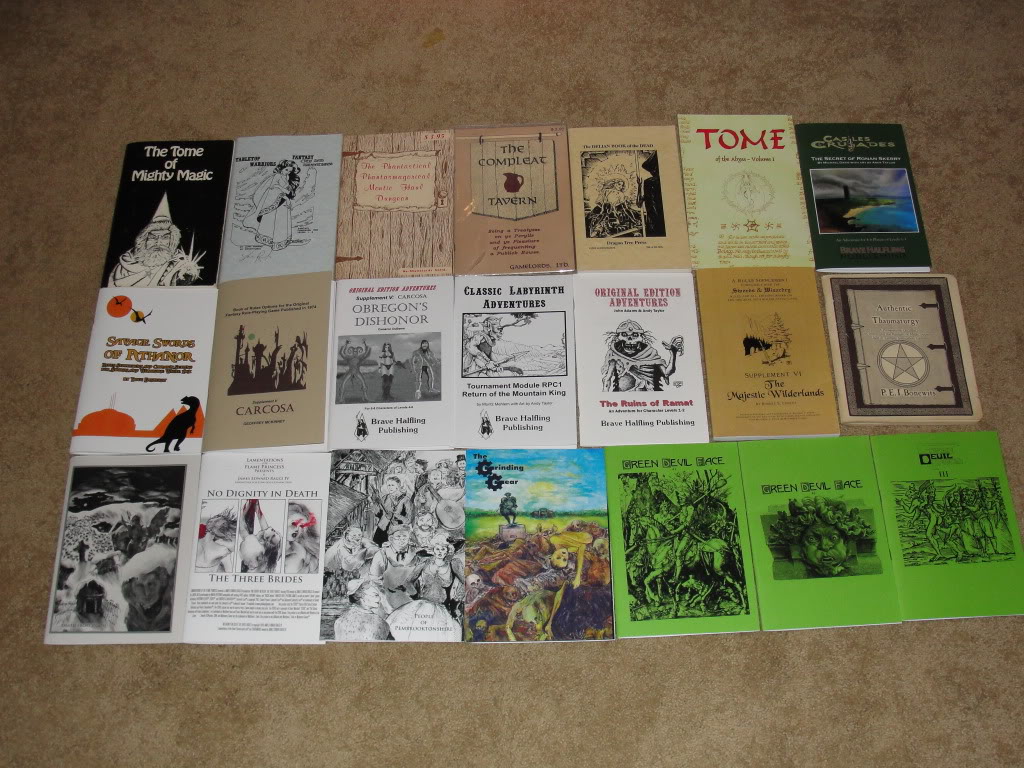
A trend among old school do-it-yourself RPG fans has been producing publications using the digest format of the original whitebox D&D books. I love gaming books this size - they fit great behind the DM screen and they are easy to conceal from onlookers and snoops! The new Brave Halfling edition of Swords and Wizardry: Whitebox in particular is brilliant because you can order (or print out) extra player copies of any of the booklets. Carcosa and James Raggi's various creations, among others, are also notable recent digest format pubs...


30+ years ago there was a very high level of enthusiasm for digest-sized gaming material, from rulebooks to supplements to zines. Look at these recent collectors' posts to a thread on The Acaeum. The incredible diversity of amazing looking zines and DIY rule supplements is especially striking. Before blogs and internet forums these zines were the primary mode of communication. I'd love to browse through some of these super rare and obscure old publications. "Monsters! Monsters! Monsters! Galore!" looks like a good one, but it's currently going for $395 at Noble Knight, so I probably won't be flipping through that one any time soon.


Sunday, April 25, 2010

Let's Look at the Sun

Let's look at the sun today, shall we?

(CLICK IMAGES TO ENLARGE AWESOMENESS)

NASA's new Solar Dynamics Observatory is starting to pump out some lovely data. Here is a composite color image of the sun from March 30, 2010 showing hot plasma, UV radiation, and flares:


Speaking of flares, look at this amazing SDO video of the flare in the upper left corner of the above image:


Here's another nice flare picture:

Gigantic magnetic tubes of hot gas (aka spicules) on the sun's surface:

A sun halo over Cambodia:

Blue image of sun highlighting hydrogen-alpha spicules:

Martian sunset:

Images from NASA's APOD site.

Friday, April 23, 2010

Should DMs Tell Players What They Need To Roll?

I am currently running two D&D campaigns – one using the original D&D whitebox rules, and one using Labyrinth Lord, which is a clone of the early ‘80s Basic/Expert Sets. In the Labyrinth Lord game I usually DON'T tell players what they need to roll to hit an opponent in combat. I allow them to deduce how tough their opponent is by whether or not their die rolls produce an effect. In my whitebox game I usually DO tell the players what they need to roll to hit.

I have noticed something interesting happening in the whitebox game. With each die roll there is a certain heightened tension where everyone is gathered around the table with bated breath, watching the die, hoping it will come up nice. It's like playing craps in Vegas. If a hit comes up there are cheers and high-fives, if it's a miss there are groans.

Contrast this with the Labyrinth Lord game, where each die is quickly thrown and then followed by a short discussion of what the opponent’s armor class might be. A somewhat more cerebral gaming experience, to be sure.

As an experiment, in our last whitebox game I switched over to the “secret to hit” roll. The cheers were instantly replaced by the armor class deduction discussions. Very interesting.

I made a post at the OD&D Discussion board asking other DMs if they tell players what they need to roll to hit an opponent in combat. Twelve people responded. Only ONE person said they regularly share this information with players… Lo and behold it was James Raggi who said:
“Such secrecy bugs me, as it serves no purpose other than to give me more stuff to keep track of and I'm not so interested. I just tell the players their opponents' AC, and they tell me if they hit. I figure anyone locked in combat will have a pretty good idea of how difficult it is to damage their opponent anyway.”


One of the twelve respondents, Finarvyn (the OD&D forum administrator), said he sometimes tells players what they need to roll:
“Often I'll not tell the players the first time they encounter a monster, but after they hit a time or two I'll share that information to save time.”


TEN of twelve were all very adamant about not telling players what they need to roll. I think these views were summed up nicely by howandwhy99:
“Never. Or for any roll. It defeats the entire design of the game, if a referee does this. IMO it is the purpose of the game for the players to figure out what works and how through play.”

It is interesting to note that the original 1975 TSR character sheet had no AC / To Hit chart (or saving throws, armor class, or hit points for that matter). This implies a gaming style where the DM kept track of most target numbers:

Image from The Acaeum.


Contrast the 1975 character sheet with the 1980 character sheet (what I use for all my games), which clearly states the "TO HIT ROLL NEEDED", along with savings throws, etc. This implies the players should have and use this information:


Based on my own thoughts, and input from the OD&D Forum posts, I tried to summarize arguments for both styles of play...

Arguments in favor of telling players:
  • It seems reasonable that a PC could quickly surmise its opponent’s toughness
  • Vegas-like excitement for rolling a target number
  • AC/To Hit chart on old TSR character sheets implies this should be open knowledge
  • Faster and easier
  • Makes it harder for DM to fudge

Arguments in favor of secrecy:
  • The player, not the PC, should surmise its opponent’s toughness by deduction
  • Your roll model Dave Arneson said "Don't ask me what you need to hit. Just roll the die and I will let you know!"
  • Adds a fun mystery element – players need to track rolls to infer opponent’s AC
  • Makes it easier for the DM to fudge
  • The first TSR character sheet did NOT have AC/To-Hit chart (for those folks who want to keep it "Oldest School")

I enjoy playing both ways, so for a time I'll probably try Finarvyn's model and switch back and forth depending on the situation. For weird, new, or mysterious opponents keep it a secret. For common stuff like goblins let them know. We'll see how it goes!

Wednesday, April 21, 2010

1980s D&D Needlepoint

Why exclude grandma from the fun?


Over at Dragonsfoot a discussion is just starting to brew about the strangest D&D items ever produced. The usual contenders like the wood burning kit, beach towel, and wind up toys make a showing. Something I had never seen before, however, are these crazy needlepoint kits (pictures posted by Egg of Coot).

Frank Mentzer comments:
When Kevin Blume became President of TSR in the '80s, his wife wanted him to support her hobby too, so he bought her a company: Greenfield Needlewomen. They did 4 different D&D kits, but the bulk of their line is of course the usual assortment of needlepoint projects. (They were sold off long before WotC got interested in TSR.)

Tuesday, April 20, 2010

Nice Players' Maps From Whitebox Game

Here are maps drawn by players in our current whitebox D&D game. One player focused on Level 1, while another player picked up Level 2. If interested, you can read session reports and other notes for our whitebox World Oranj campaign to better understand some of the mapped features.

Level 1 of Morton's Compound:
(CLICK IMAGE TO ENLARGE)


Level 2:
(CLICK IMAGE TO ENLARGE)
 

Note the isolated Wizard Room lost in time and space... The players found this during the game last Sunday. I will try to write up a session report some time later this week.

Monday, April 19, 2010

Guess I'm a 100-sider


I am a d100


My results for the dicepool.com quiz:
You are a d100: You're a bit odd, to put it mildly. We're not sure whether you're socially inept, brain damaged, or just trying to be funny. We've given up on trying to figure it out, and have to accept that it might be all three. For you, non-sequitur are the most common form of non-communication. You are given to great flashes brilliance, but don't have the attention span to carry out any of your most ingenious plans. We don't know what color the sky is in your world, and frankly, we're afraid to ask.

This is actually an amazingly accurate result...

For the record, the sky in my world is orange-ochre, but the PCs just entered into a new underground world illuminated by yellow phosphorescent fungus.

Thanks to Jeff's Gameblog, Dungeoneering Dad, and Trollsmyth for the hot new trend sweeping the blogoverse!