Friday, July 16, 2010

For Aphex Twin Fans

Cool steel drum version of Alberto Balsam:


If you've never heard of Aphex Twin before, start by watching this Windowlicker video. The music starts at about 4:30, but the whole video is entertaining. WARNING: PROFANITY!

Simple Multi-Ability Checks in Classic D&D


Over at The Eiglophian Press G. Benedicto made a nice post on ability checks in Classic D&D. It turns out that we both use the same general method - rolling handfuls of 6-siders, where a success occurs if one rolls the target ability score or under. For lack of a better name, the algebratron in me has always called this the “xd6” method, while Mr. Benedicto calls it “ESDVAN” for:

Easy: 2d6
Standard: 3d6
Difficult: 4d6
Very Difficult: 5d6
Arduous: 6d6
Nigh-Impossible: 7d6

For instance, if a character wants to break down an average door I’ll have her throw 3d6 to see if she can roll her Strength or under. Really heavy door? 4d6. Iron-braced door? 5d6. Works great! I particularly like this method because of its scalability and bell-curved probabilities. It’s much more useful than rolling a d20, which is another common method for D&D ability checks.

In most situations it’s pretty obvious which ability score is appropriate for the problem at hand, although sometimes I wish I could combine two abilities for a check. For instance a few sessions ago someone wanted to do a complex long jump / oil flask toss move. I had them check against Dexterity, which was fine, but I was kind of wishing I could include a Strength component as well. After thinking about it a bit yesterday, this simple solution came to mind: Roll against the sum of the two abilities using d12s:

Easy: 2d12
Standard: 3d12
Difficult: 4d12
Very Difficult: 5d12
Arduous: 6d12
Nigh-Impossible: 7d12

The maximum possible value for the sum of two ability scores is 36, which is also the maximum possible roll for 3d12. Anyway, I need a use for all those dodecahedrons in my dice horde…

Thursday, July 15, 2010

Old School ≠ Kill-n-Loot

“Remember the good old days, when adventures were underground, NPCs were there to be killed, and the finale of every dungeon was the dragon on the 20th level? Those days are back. Dungeon Crawl Classics don't waste your time with long-winded speeches, weird campaign settings, or NPCs who aren't meant to be killed. Each adventure is 100% good, solid dungeon crawl, with the monsters you know, the traps you fear, and the secret doors you know are there somewhere.” - Dungeon Crawl Classics website

“Of course, if your players are not money grubbing tomb-robbing misfits, they are probably doing something wrong in the first place and don't deserve to level (I hear alot about these new-agey indie/story games). Isn't this a core conceit of old school rulesets? “ - Lord Bodacious (in a comment to my last post)
These two quotes I think crystallize a strong notion among many people that old school RPGs are, at their core, all about killing monsters and stealing treasure.  I have never understood this stereotype. Not only do I not understand it, I think it’s harmful to the public perception of our hobby (read this stinging and highly critical Gygax obituary if you haven't already) and I think it has very little basis in reality.

Look, I have complete respect for my pals that like to spend their hours imagining they’re running around a maze, stabbing orc babies in the face, stealing little “Gold Pieces”. This is a cool weird diversion I thoroughly enjoy myself on occasion. I do not believe, however, that this mode of play best represents the heart of 70s-style paper and pencil gaming. I think it mostly represents (1) the first early-70s experiments where wargaming began mutating into RPGs at Dave Arneson’s house, (2) early-80s D&D fad gaming, and (3) current 4e “D&D Encounters” boardgame-style play. So, yes, from the earliest days of D&D there have been kill-n-loot gamers, but I don’t detect a significant association with this play style specifically with 70s RPG culture. If anything, kill-n-loot mostly represents the style of play I see in the 4e RPGA rooms at modern gaming conventions. If you want to go by the numbers, kill-n-loot is thoroughly new school, strongly appealing to the modern generation of gamers weaned on World of Warcraft and console games.

I must admit that the only dungeon crawling I was doing in 70s was on the floor in diapers, so I have no first-hand experience of the play styles of the era. Thus, in my broaching this topic I willingly open myself to criticism and retort. I do see, however, much evidence that kill-n-loot wasn't the only game in town in the 70s.

Many printed artifacts in particular soundly reject the hypothesis that all prominent mid-70s gamers focused on kill-n-loot dungeon crawls. My favorite of these is Empire of the Petal Throne (TSR 1975) - a self-contained OD&D-based game that has pages and pages of compelling storylines, weird campaign settings, and awesome NPCs. The players’ goal in EPT is to advance in standing in a complex and socially stratified city-state. Sure, you can kill weird alien monsters and get some money on the way up the social ladder, but killing and looting isn’t the point. To me, EPT is what it’s all about. This is the spirit of the old school RPGs I love the most. There is so much more mind blowing RPG material from the 70s with highly imaginative settings and scenario possibilities: Metamorphosis Alpha (TSR 1976), Traveller (GDW 1977), City State of the Invincible Overlord (Judge’s Guild 1976), Gamma World (TSR 1978) and on and on. Kill-n-loot? What?

Furthermore, the oldest DMs I’ve played with – guys who have been gaming continuously since the 1970s using old school rulesets - all have imaginative story arcs, complex homemade worlds, and awesome NPCs. Although I’m sure they exist, I personally don’t know any 30+ year RPG veterans that run kill-n-loot campaigns. Convention one-shots? Yes. Campaigns? No. And campaigns are what it’s all about – just read the OD&D rulebooks.

So where does the loot-n-kill stereotype come from? Certainly many of the early (and celebrated) TSR and Judge’s Guild D&D modules had paper-thin scenarios emphasizing killing monsters and stealing treasure. As well, the rules of most D&D editions require killing and looting to advance in level. Okay. But there are two assumptions at play if you want to extend these facts to say “Old school RPGs are all about looting and killing”. The first assumption is that the primary goal of most D&D players is to advance in level. In my experience, this is not accurate at all. In my two current campaigns my players are showing almost zero interest in playing-to-level. It’s almost like piles of treasure are a nuisance to them. It's not just my game - as the comments to my last post and this post by Jeff Rients illustrate, many DMs running old school D&D campaigns, including Dave Arneson himself, house-rule to give experience points and allow leveling for activities other than killing and looting. The second assumption is that D&D is the prime representative of old school gaming. Now, I love classic D&D and play it more than any other game, but there was a Cambrian-like explosion of other highly imaginative RPGs and supplements in the 70s that deserve more recognition (and table time).

Ultimately, evidence and anecdote lead me to the impression that a significant portion of mid- and late-70s RPG activity was centered around creating interactive experiences where players could “walk into” a story such as Robert E. Howard, Brian Aldiss, or Jack Vance would have dreamed up. This is what I think of when I hear “Old School RPG” and this is what John Eric Holmes was excitedly trying to describe in his 1981 book Fantasy Role Playing Games. As far as I can tell, racking up Gold Piece Points in a tedious proto-videogame has no particular relationship with old school gaming.

Tuesday, July 13, 2010

How Do I Fix Slow Leveling?

In the last year or so I’ve run around 20 sessions of old school D&D using the OD&D, Labyrinth Lord, and Sword & Wizardry rules. These systems are all basically the same game, differing only in fairly minor ways. They all share the basic experience / leveling system, where characters gain experience points (XP) by killing monsters and getting treasure, and the resulting XP then lead to level advancement. As a DM I have been doling out XP by-the-book.

My steady campaigns are having problems with this system, however. It’s taking a really long time for my players to level-up. Much longer than average, based on this discussion at Dragonsfoot. In fact, it took over ten ~4hr sessions for the players in my Labyrinth Lord game to get to 2nd level. Ideally, I’d like to aim for the optimal-fun target of leveling up every four sessions or so. I think the characters deserve it, really. After 15 sessions the LL game has seen three major locality-based “chapters”. They’ve been through a lot and rocked real hard. I feel they should at least be 3rd level by now. It would also be more fun for me as a DM if they got tougher faster, so I could start throwing different kinds of challenges at them besides wheezing goblins and diseased monkeys.

Leveling is happening slowly because:

1. My players are showing minimal enthusiasm for killing monsters and finding gold for its own sake. They like achieving goals, roleplaying, and exploring. So do I, for that matter.

2. I’m stocking treasures based on recommendations in Moldvay’s Basic Set book. I am even being more generous than the book. Still, the pickings are meager.

3. There’s still a lot of monster murder going on, but by-the-book monster XP values are low and the party size is big enough that very little XP result from slaughtering gaggles of giant rats and mumbling stink-eyed psychopaths.

First of all, I should say that I really like the old school concept of experience leading to leveling. It’s clean and simple and fun for players. I think “levels” are cool for both aesthetic and practical reasons, and I have no desire to house-rule a more modern and sensible character customization system. Given this, I am now considering these possible methods of speeding up leveling in my campaigns:

1. Give out more treasure. I’ve been trying this, and it’s working. But now the players are loaded with more cash than they know what to do with. The sweet little angels have actually started donating their gold to charity because they can’t carry it all! It’s kind of ridiculous, actually. To get to 4th or 5th level they’ll start needing wheelbarrows of holding for all the treasure.

2. Give out more XP for gold and monsters. This could be a good solution, but it still doesn’t address the fact that my players, bless their tender hearts, aren’t highly motivated by burglary and murder.

3. Use something like the 4e system where players advance after a certain number of combat encounters. This is appealing for its simplicity, but again, the focus on killing to advance doesn’t jive with the atmosphere of our exploration- and RP-heavy games.

4. Use Lord Kilgore’s roll-to-advance rules. Read them HERE. With this system each player gets 1 XP per session. After each session each player rolls against a class-specific value, modifying the role with their total XP - make a good roll, you level! Nice and clean. Pretty appealing actually.

5. Allow characters to level based on the number of hours they’ve been playing. For instance, maybe characters could level for every 12 hours of gaming. I’ve never heard of anyone doing this, but it seems like it might work pretty well. Has anyone tried this before?

This is one of the oldest and most worn-out topics in D&D, but it’s still highly relevant to anyone running an old school D&D campaign. It would be a big midstream switch for us to move to a new level advancement system. I’d be curious to get input from anyone else who has confronted this. What have you tried? How has it worked? What would you recommend?

Monday, July 12, 2010

Sunday, July 11, 2010

Shatner Choppers

Right Side:
 

Left Side:

On the chopper - lookin' great, Boston Legal!

Model Photo:

Star Trike:

Thursday, July 8, 2010

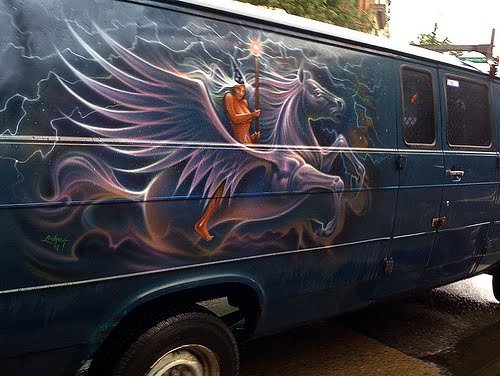
More Fantasy Van Murals

Riffing off of Grognardia's earlier treatment on the topic, I thought I'd post some additional remarkable van mural pictures I've collected while trawling the internet. Seeing vans like these when I was a kid always made my day. Luckily, around Southern California you can still spot them occasionally, especially those with supernatural Aztec murals. A few months ago in my neighborhood I saw a truck fully muralized for the heavy metal band Man-O-War and I started screaming to my wife with excitement - I wish I had a camera for that one.